
Picture this. It is mid afternoon in Shillong, and a crowd has gathered at an open ground. A line of archers stands at a marked distance, bamboo bows in hand, facing a tall straw target. On a signal they begin to shoot, arrow after arrow, while spectators watch in near silence. Minutes later, officials walk up to the target and start counting the arrows stuck in it. Then a number goes up on a board, and the crowd reacts. That number is a Shillong Teer result, and the whole scene you just imagined is the answer to the question “what is shillong teer.” This guide explains the game the way it actually unfolds: round by round, step by step, from the ticket counter in the morning to the final declaration of the day.
What Is Shillong Teer in Two Minutes
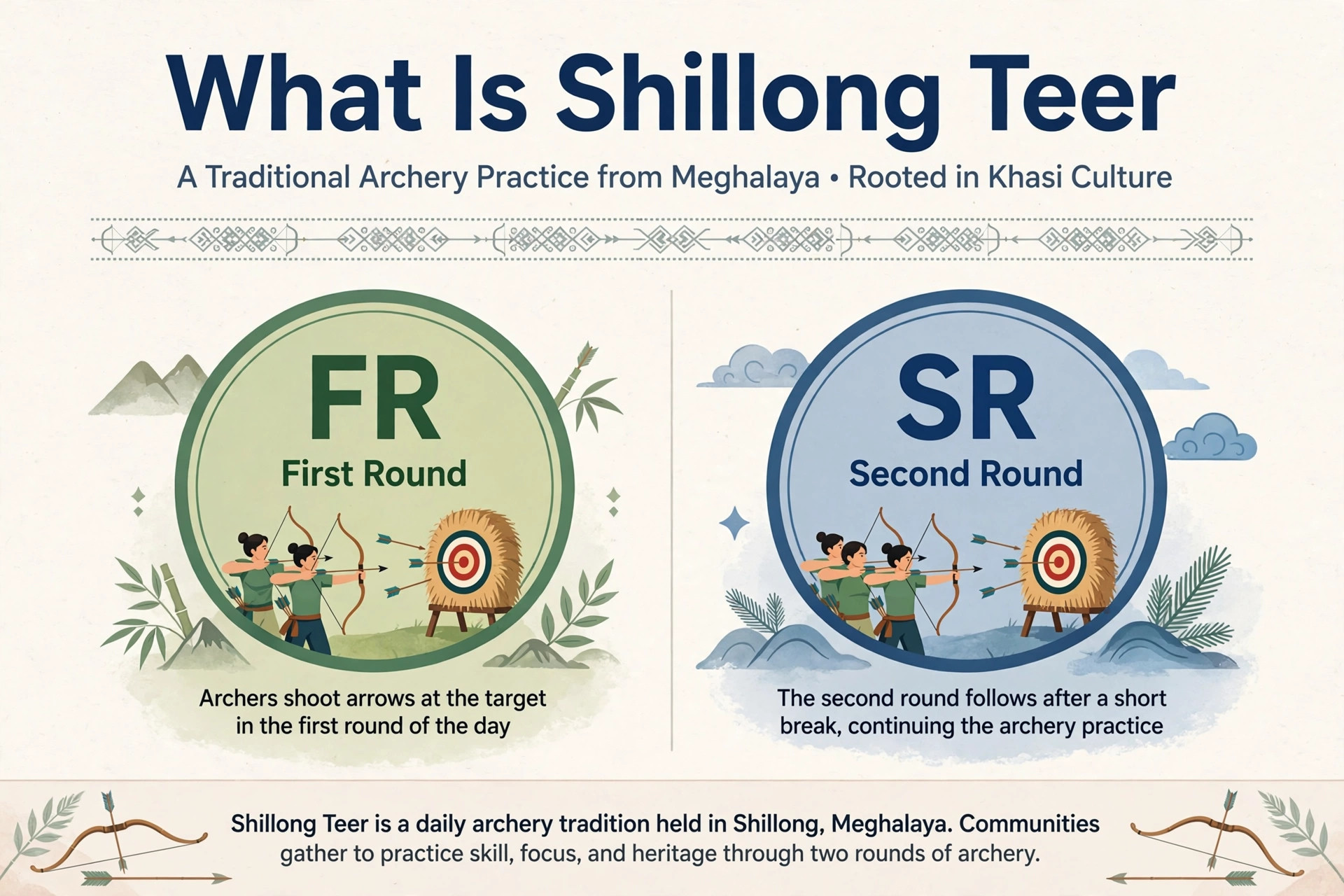
If you want the shortest possible explanation of what is shillong teer, here it is. Shillong Teer is a government licensed lottery in Meghalaya built on competitive archery. Twice a day, a group of archers shoots arrows at a traditional target. Officials count the arrows that hit. The last two digits of that count become the result for the round. People buy tickets at licensed counters predicting that two digit number, and correct predictions win fixed prizes.
That is the entire game in five sentences. Everything else, the history, the clubs, the timings, the result cards, is detail around this core loop: shoot, count, declare. Keep that loop in your head as you read on, because every section below is just a closer look at one part of it. The Wikipedia article on Teer describes the same loop from an encyclopedic angle if you want a second source.
How the Shillong Teer Game Works, Step by Step
The best way to understand how teer works is to follow a single playing day from start to finish. The day has a rhythm, and once you learn it, the jargon stops being intimidating.
Step 1 – Ticket Counters Open in the Morning
Licensed teer counters across Shillong open in the morning. These are the only legal places to buy a ticket. Each ticket is for a specific round on a specific day: you choose the First Round or the Second Round and the two digit number you want to back. Counters display the prize structure openly, so buyers know exactly what a winning ticket pays before they spend anything.
Ticket sales for the First Round close before its shooting begins. There is a cutoff, and it is strict. Anyone who arrives after the cutoff simply waits for the next round. This discipline around cutoffs is part of what keeps the game orderly.
Step 2 – Archers Gather and the First Round Is Shot
In the afternoon, the archers assemble at the shooting ground. They take their positions at the shooting line, the target is confirmed ready, and the round begins. Each archer shoots their allotted arrows in an organized sequence. Spectators watch from designated areas. The shooting itself takes a defined period, not rushed, not dragged out, and when the last archer has shot, the round is over.
Step 3 – Officials Count the Hits
Officials move to the target and count every arrow embedded in it. This is the moment the sport becomes a lottery result. The count is done in the open, witnessed by club representatives, and the total is agreed before anything is announced. Nothing about this step is hidden, which is precisely the point.
Step 4 – The FR Result Is Declared
The last two digits of the hit count are announced as the First Round result. The number goes up on boards at the ground, counters update their displays, and online publishers begin posting it. Ticket holders compare their FR tickets against this number. Winners are paid according to the published prize rules.
Step 5 – The Second Round Repeats the Whole Cycle
After a break, the cycle repeats for the Second Round: shooting, counting, declaration. The SR result is independent of the FR result. Counters settle SR tickets, and the day’s play concludes. By evening, both results are a matter of public record.

The Archers and Their Equipment
The archers deserve a closer look, because they are what separate the teer game from every other lottery in India. These are not random volunteers. They are club archers from the Khasi Hills, many of whom compete in conventional archery tournaments as well. General archery references cover the sport’s basics, but teer archery has its own traditional flavor.

Traditional Bamboo Bows
Teer archers shoot with traditional bamboo bows and bamboo arrows, made by hand in the local style. There are no sights, no stabilizers, no mechanical releases. Accuracy comes from years of practice: stance, draw, anchor, release, follow through. Because the equipment is simple, the variation in shooting comes from human factors, which is exactly what makes each round’s hit count unpredictable.
The Shooting Line and the Target
Archers shoot from a marked line at a fixed distance from the target. The target is a tall upright cylinder of tightly bound straw, presenting a narrow face to the archers. Hitting it consistently with a simple bamboo bow at distance is genuinely difficult, which is why hit rates are well below one hundred percent and why the final count varies from round to round.
How Many Arrows Fly in One Round
Each archer shoots a set of arrows, commonly described as several dozen per archer per round. With a few dozen archers on the line, a single round sees thousands of arrows in the air. The total that actually stick in the target might be anywhere in the high hundreds or low thousands. That large, variable total is what feeds the result rule: take the last two digits, and you get a number between 00 and 99 that nobody could have known in advance.
Counting and Declaration Mechanics
Beginners often ask whether the counting could be manipulated. The honest answer is that the system is designed to make that very hard, and understanding the design helps you trust the results you read online.
The Count Happens in Public
The single most important fact about the count is that it happens where people can see it. Officials do not take the target away into a back room. They count at the ground, in front of club representatives and spectators. Every arrow in the target is visible. If you ever visit Shillong, watching the count is the single best way to convince yourself the process is real.
Only Stuck Arrows Count
The rule is strict: an arrow counts only if it is embedded in the target face. Arrows on the ground, arrows in the stand, arrows that glanced off, none of these count. This strictness removes judgment calls. Either the arrow is in the target or it is not, and anyone watching can verify each one.
From Total to Two Digits
Once the total is agreed, the result is mechanical: keep the last two digits, drop the rest. The numbers below are examples only, not real results: a count of 1,458 becomes 58, a count of 730 becomes 30, and a count ending in single digits is written with a leading zero, so a count of 1,205 becomes 05. There is no rounding, no weighting, no adjustment. The simplicity of the rule is a feature, because it leaves no room for interpretation.
Declaration Is the Official Moment
The result becomes official when it is declared at the ground and communicated outward. Until that moment, any number circulating is unofficial chatter. Reputable online pages, including the Shillong Teer result page, publish the number only after the declaration, and show a placeholder like “-” for rounds that have not been declared yet. If you ever see a site displaying a result long before the usual declaration time, treat that number as fiction.
Result Timings: Your Daily Schedule
Timing questions dominate every beginner’s search history about the teer game, so here is the daily schedule in plain terms. All times are Indian Standard Time and describe the usual pattern for the main sessions.
Shillong Afternoon Session
The flagship session runs in the afternoon. The First Round is typically shot and declared around 3:45 PM, and the Second Round follows with its declaration around 4:45 PM. These are the two moments that matter most to followers of Shillong Teer. Ticket counters close sales for each round ahead of its shooting, so the cutoff always comes before the declaration time you see published.
Morning Session
A morning teer session serves the early part of the day, with its two rounds generally declared in the late morning window, roughly around 10:30 AM and 11:30 AM. It follows the same shoot, count, and declare cycle as the afternoon session, just on an earlier clock. Beginners sometimes confuse morning results with Shillong afternoon results, so always check which session a number belongs to.
Juwai and Khanapara Centers
Juwai and Khanapara run their own teer centers with their own archers, their own grounds, and their own declared results. Their rounds are scheduled in the afternoon along the same lines as Shillong, each center declaring its FR and SR independently. A result from Khanapara is a Khanapara result, full stop. It says nothing about what Shillong declared the same day. The Juwai Teer result page and the Khanapara listings follow the same labeled format.
Night Session
An evening night session rounds out the day for those who follow it, with declarations in the night hours. The mechanics never change across sessions: two rounds, counted hits, two digit results. Only the clock time and the shooting ground differ.
Days With No Play
Sundays are normally off for the main Shillong session, and festival holidays pause play as well. On such days there are simply no rounds, no counts, and no results. A trustworthy result page shows the day as blank or marked closed rather than recycling an old number, and that honesty is exactly what you want from a source.

Reading the Result: FR, SR and Center Labels
A result is only useful if you read it correctly. Every proper teer result display, on a board or on a screen, carries four pieces of information, and you should check all four every time.
First, the center: Shillong, Juwai, Khanapara, morning, or night. Second, the date: teer results are strictly daily, and yesterday’s number cannot settle today’s ticket. Third, the round: FR or SR, because the two rounds of the same day are independent contests. Fourth, the two digit number itself.
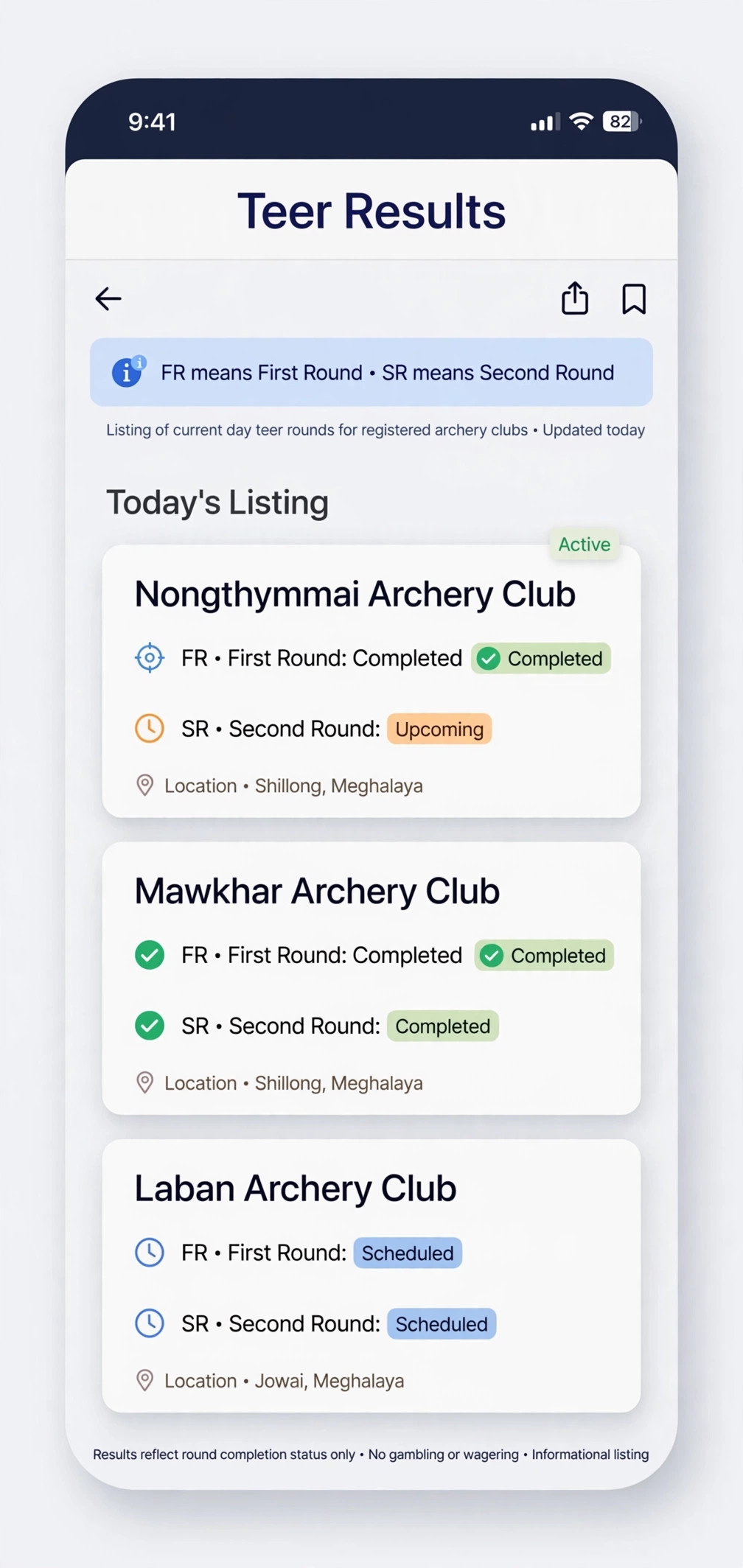
The most common beginner error is skipping one of the labels. Someone checks an SR number against an FR ticket, or reads a Khanapara result as a Shillong one, and concludes the system cheated them. It did not. The labels were there all along. Make it a habit: center, date, round, then number. On the teer result list page, each round is published with exactly these labels, so you can practice the habit there.
One more thing to watch for is the placeholder. Before a round is declared, an honest page shows “-” or a similar marker instead of a number. That dash means the round has not happened yet. Any number shown before declaration time is not a result, no matter how confident the page looks.
A Short History of the Shillong Teer Game
The shillong teer history did not begin with tickets and counters. It began with the bow. Archery has been part of Khasi culture in the hills around Shillong for centuries, first as a hunting skill and then as a celebrated community sport. Village archery contests were major social events, and spectators wagering on the outcome was a natural, informal part of the festivities.
Over generations, the wagering side grew more organized. What started as friendly bets among onlookers gradually became a structured activity with regular contests, recognized organizers, and eventually printed tickets. The state government of Meghalaya chose to regulate rather than prohibit it, bringing the game under the Meghalaya Amusements and Betting Tax Act. Licensed operators, authorized counters, and tax revenue followed, and the informal pastime became the legal meghalaya teer lottery known today.
The Khasi Hills Archery Sports Association emerged as the organizing body for the sporting side, coordinating the clubs and overseeing the conduct of rounds. That dual structure, a sports association running the archery and licensed operators running the lottery under government supervision, is what makes the system unusual in India and what keeps it running openly instead of underground. For the official view of the state itself, the Meghalaya government portal is the authoritative starting point.
Where to Check Results Online
If you are not in Meghalaya, a good online result page is your window into the game. Judge any source by four tests. It publishes each round only after declaration time. It labels every number with center, date, and round. It keeps a short visible history so past results can be checked. And it shows a placeholder for undeclared rounds instead of inventing numbers.
Pages that fail these tests, showing numbers impossibly early, mixing prediction content with results, or hiding dates and round labels, are not worth your trust. The Teer Result Now homepage is maintained to the standard described in this guide: declared results only, clearly labeled, updated round by round through the day.
What Is Shillong Teer: Frequently Asked Questions
What is Shillong Teer in simple words?
It is a legal archery lottery in Shillong, Meghalaya. Archers shoot arrows at a target twice a day, officials count the hits, and the last two digits of the count become the result for that round.
What do FR and SR mean?
FR stands for First Round and SR stands for Second Round. They are the two independent daily contests. Each has its own tickets, its own shooting, its own count, and its own result.
How is the result number actually calculated?
Officials count every arrow stuck in the target. The result is the last two digits of that total. For example only, not a real result, a count of 1,389 would give a result of 89. Missed arrows do not count.
At what time are results declared?
Usually FR around 3:45 PM and SR around 4:45 PM IST for the main Shillong session, with morning rounds around late morning and a night session in the evening. Timings can shift slightly, so check a live result page on the day.
Are Shillong Teer results the same as Juwai or Khanapara results?
No. Each center runs its own rounds with its own archers and declares its own results. Always confirm which center a result belongs to before comparing it with a ticket.
Is it legal to play?
Yes, under Meghalaya state regulation, through licensed counters only, and only for adults aged 18 and above. It is a game of chance, so play responsibly and never spend money you cannot afford to lose.
Why do some sites show a dash instead of a number?
The dash means the round has not been declared yet. It is a sign of an honest page. Any site showing a number before declaration time is not showing a real result.
Play Responsibly
A brief but necessary note. Teer is a legal lottery in Meghalaya for adults 18 and older. It is pure chance: no pattern, tip, or prediction can influence how many arrows hit a target. If you play, decide your budget in advance, never chase losses, and stop the moment it stops being entertainment. You can enjoy the archery, the tradition, and the daily rhythm of the game without spending anything at all.
Conclusion
What is shillong teer, finally? It is shoot, count, declare, twice a day. Archers with bamboo bows, a straw target, a public count, and a two digit result that anyone can verify. The FR and SR rounds give the day its structure, the open counting gives the game its credibility, and the fixed timings let you follow along from anywhere. Now that you know how the teer game works from the ticket counter to the declaration board, you can read any result card with confidence, tell the centers apart, and spot an untrustworthy source in seconds. That is everything a beginner needs, and it is also, at its heart, everything there is.