Every Khanapara Morning Teer result you read is the final score of a real sporting contest held that same morning. Two rounds of archery, dozens of archers, hundreds of arrows, and a careful count by officials: that is what stands behind the two small numbers on your screen. Most readers never think about this machinery, but understanding it changes how you read results. You will know why FR always comes before SR, why the numbers appear when they do, why two rounds exist instead of one, and why the system is fair. This is a deep dive into the mechanics of the morning session, from the first arrow to the declared number.

Inside the Two Rounds Behind the Khanapara Morning Teer Result
The morning session at Khanapara is not one lottery but two, held back to back every single day. The first round, FR, is a complete archery contest: archers shoot, officials count, a number is declared. Then the second round, SR, repeats the entire contest from scratch with fresh shooting. The two rounds share the venue, the day, and the rules, but they share nothing else. Different arrows are shot, different counts are made, and different numbers emerge.
This independence is the most important mechanical fact about the game. The FR number cannot influence the SR number because the SR arrows have not been shot when FR is declared. There is no carryover, no adjustment, and no connection. Each round starts at zero and ends with its own count. When you read the Khanapara Morning Teer result, you are reading two separate sporting outcomes that happen to be displayed together for convenience.
The two round structure also doubles the rhythm of the morning. Ticket sale, shooting, counting, declaration: this cycle runs once for FR, then the venue resets and the cycle runs again for SR. The whole session typically completes before midday, with FR usually declared between 10:30 and 11:00 AM and SR following between 11:30 AM and 12:00 noon. The gap between the rounds is not empty time; it is when the venue prepares the second contest.
The Archery Round, Step by Step
Every round, in every session, follows the same physical steps. Understanding them makes the timing and the numbers intuitive.

The Setup
Before shooting begins, the target is prepared and the archers take their positions at the regulation distance. The target used in teer is traditionally made of bamboo, a nod to the sport’s heritage among the Khasi people of Meghalaya. Officials verify that everything is in order: the target, the shooting line, and the count of arrows to be shot in the round. Ticket sales for the round close before this point, so the field of participants is fixed.
The Shooting
The archers shoot their arrows at the target in a coordinated manner. A round involves a set number of arrows shot by the participating archers. The shooting takes a defined amount of time; it cannot be rushed without harming accuracy, and accuracy is the point of the sport. Spectators at the venue watch the round unfold live, which is part of the game’s enduring appeal as a community event.
The Counting
Once shooting ends, officials count the arrows that hit the target. This is the most delicate step. Every hitting arrow must be counted, and the count must be exact, because the winning number derives directly from it. Officials perform the count carefully and verify it. Only when the count is confirmed does the round move to declaration. The care taken here is why declarations follow shooting with a short delay rather than instantly.
How the Khanapara Morning Teer Result Number Is Calculated
The conversion from count to winning number is elegantly simple: take the total number of arrows that hit the target, and keep only the last two digits. That two digit figure, from 00 to 99, is the declared number for the round. If the count ends in a particular pair of digits, that pair is the result. There is no formula beyond this, no weighting, and no adjustment.

This method has a beautiful property: it is transparent. Anyone present at the venue can follow the count and derive the number themselves. There is no black box, no machine, and no hidden step. The number is a direct, readable function of what happened on the field. That transparency is a large part of why players trust the game; the result is visibly earned by arrows, not produced by an unseen process.
The two digit format also defines the ticket. Each ticket carries a number from 00 to 99 chosen by the player. Matching the declared number wins the round. With one hundred possible outcomes, every ticket has the same mathematical chance in every round, and every round is a fresh start. The simplicity of the format is why the result card can be so compact: a session name, a date, and two two-digit numbers carry the entire outcome.
FR Versus SR – Same Rules, Separate Events
It is worth stating the FR and SR relationship with mechanical precision, because it answers half the questions readers ask. The rounds use identical rules: same distance, same target type, same counting method, same two digit derivation. What differs is everything else: the arrows shot, the archers’ form in that moment, the light, the wind, and therefore the count. The SR round is not a continuation of the FR round; it is a new contest.
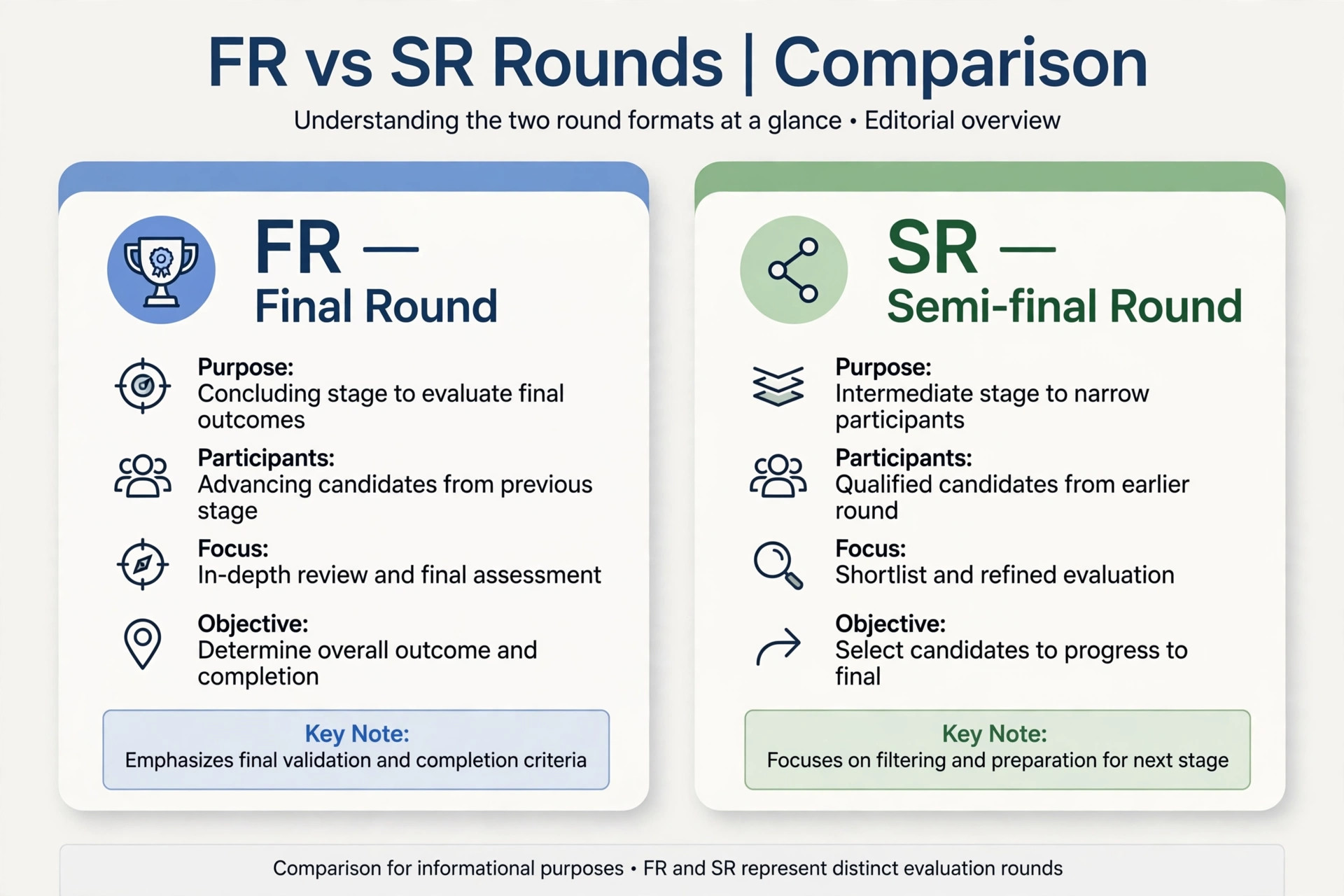
This is why the result page shows FR first and SR later, and why a dash marks the round still to come. The display mirrors the venue: the first contest completes, its number is declared, then the second contest runs. Any source showing both numbers before the first contest could have finished is not describing reality. The mechanics enforce the order, and the order is your best tool for judging whether numbers you see are genuine.
The independence also settles the most common superstition. Because SR is a new contest, nothing about the FR number constrains it. The archers do not aim to produce a related number; they aim at the target, and the count falls where it falls. Past rounds, whether FR or SR, morning or afternoon, have no mechanical path to influence the next round. Each count begins at zero.
Why Two Rounds Instead of One
The two round design serves both sport and lottery. For the sport, it gives archers two competitive outings in one session and gives spectators two contests to watch. For the lottery, it gives players two chances per session instead of one, which makes participation more engaging and the morning more eventful. A player who follows only khanapara morning teer still gets two chances every day, one per round: a player whose FR ticket misses can still have interest in the SR round, and the morning holds attention across a longer span.
The design also smooths the venue’s operations. Ticket sales can run in two waves, crowds flow in two phases, and officials get a natural break between the intense counting periods. What looks like a simple doubling is actually a well balanced schedule that has evolved over years of practice. The morning session’s rhythm, FR late in the morning and SR around noon, is the product of that evolution.
The Ticket’s Journey – From Counter to Declaration
Follow a single ticket through the morning to see how the mechanics touch the player. In the morning, the player visits a licensed counter and buys a ticket for the first round, choosing a two digit number. The sale is recorded and the ticket is in hand before shooting begins. The archers shoot, the officials count, and the FR number is declared. The player compares the ticket against the declared number: a match wins the round.
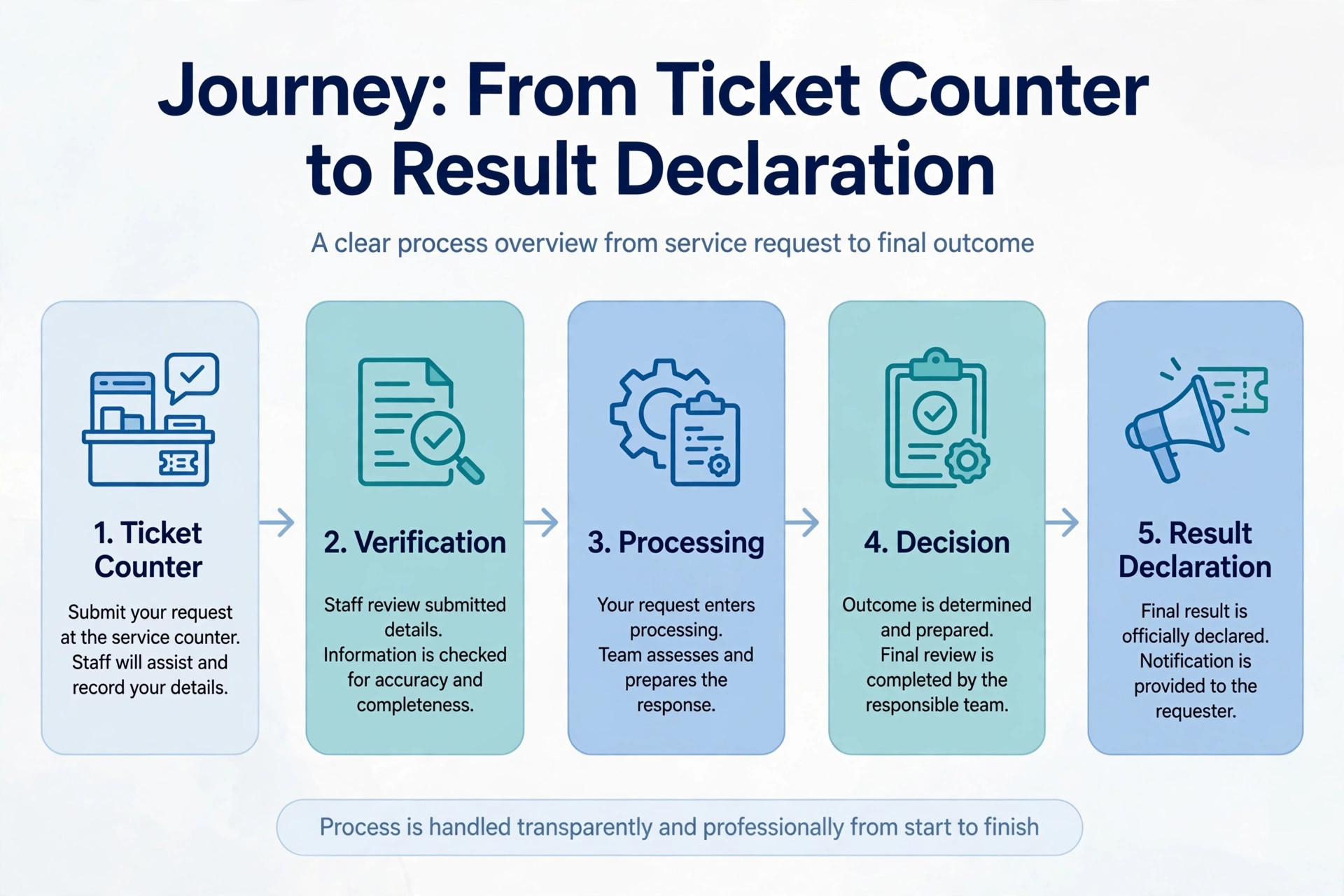
For the second round, the journey repeats. The player may buy another ticket, possibly the same number or a different one, before the SR shooting begins. The second contest runs, the second count is made, and the SR number is declared. The ticket is compared again. Two tickets, two contests, two independent outcomes. Notice how the player participates in the lottery layer while the sporting layer runs on its own; the two layers meet only at the moment of comparison.
This separation is why reading results correctly matters so much. A ticket bought for FR must be compared with the FR number, not the SR number. Mixing the rounds is the mechanical equivalent of comparing your ticket against a different contest. The result page keeps the rounds labelled precisely so this comparison is easy; your job is simply to match each ticket to its round.
What Officials Do Between Rounds
The interval between FR and SR is a working period for the venue. Officials finalise the first round’s records, confirming the count and the declared number. The target is prepared again for the second round. Archers rest and reset. Ticket sales for the second round close. Each of these steps protects the integrity of the next contest: a clean target, rested archers, verified records, and a closed field of tickets.
This intermission is also when result websites update. The FR number goes live as soon as it is confirmed, and the page then waits, honestly showing a dash for SR, until the second contest completes. The dash is the website mirroring the venue’s own state: round one done, round two pending. Understanding this makes the result page feel less like a scoreboard and more like a window onto the venue.
Why the Mechanics Resist Manipulation
Skeptical readers sometimes ask whether the numbers can be fixed. The mechanics make it genuinely hard. The number derives from a live count of arrows shot by many archers in public, at an outdoor venue, in front of spectators and officials. Fixing the outcome would require controlling where dozens of archers’ arrows land, to produce a precise total whose last two digits equal a target figure, all under observation. The difficulty is obvious.
The transparency compounds the difficulty. Because the derivation is just the last two digits of a public count, any manipulation would be visible to anyone watching the count. There is no hidden draw, no sealed machine, no back room step where interference could hide. The openness of the process is its own audit. This does not mean every venue is perfect, but the structure pushes strongly toward fairness, and the state regulation of the game adds formal oversight on top.
For the reader, the practical takeaway is confidence in the numbers themselves. The Shillong morning session runs the same two round machinery, and when its FR and SR appear after the declaration windows, those numbers are the honest product of that morning’s archery. Your task is only to read them correctly: right session, right date, right round labels.
A Walkthrough of the Derivation (Illustrative Only)
It helps to see the derivation as a recipe with no real numbers attached. Step one: the round’s shooting ends. Step two: officials count every arrow that hit the target, arriving at a total count. Step three: they look at only the final two digits of that total. Step four: those two digits are announced as the round’s winning number. That is the entire transformation, and it is the same for FR and SR.
Notice what the recipe does not contain. There is no draw, no shuffle, and no selection step. The number is not chosen; it is revealed by arithmetic from a public count. This is why spectators at the venue can work out the number themselves the moment the count is announced. The transparency is total: count, take two digits, declare.
The recipe also shows why the count must be exact. A miscount of even one arrow could change the last two digits and therefore the declared number. That is why officials count carefully and verify, and why the declaration follows counting with a short pause rather than instantly. The pause is quality control, and every honest result depends on it.
The Morning Session in the Day’s Chain
Khanapara’s morning session is the first teer event of the day, but not the only one. Readers often arrive here by searching “morning teer khanapara” or “khanapara teer morning result”, and the session is worth understanding on its own terms before comparing it with the rest of the day. The afternoon brings sessions at Juwai, Shillong and Khanapara itself, each running the same two round mechanics at its own venue, and the night sessions close the day. Every one of these sessions is mechanically independent: separate archers, separate arrows, separate counts. The full result list shows the whole chain, and reading it with mechanical understanding, each number as the product of its own contest, prevents the common error of imagining connections between sessions.
Responsible Participation
Teer is a legal lottery in Meghalaya under state regulation, for adults aged 18 and above. The mechanics described here are fascinating as sport, and many readers follow the results purely as spectators, which costs nothing. If you buy tickets, budget strictly, never borrow to play, and keep it as entertainment. The archers will shoot again tomorrow; make sure your finances are intact to enjoy watching. A neutral overview of the game is on Wikipedia.
Frequently Asked Questions
How is the Khanapara Morning Teer result decided?
By live archery. In each of the two rounds, archers shoot at a target, officials count the hitting arrows, and the last two digits of the count become the round’s number.
What is the difference between FR and SR mechanically?
Nothing in the rules; everything in the event. FR and SR are two separate archery contests with separate shooting, separate counts and separate numbers.
Why does SR always come after FR?
Because the rounds happen in sequence at the venue. The second contest cannot be counted before it is shot, so its number cannot be declared first.
How many digits does each winning number have?
Two, from 00 to 99. The number is the last two digits of the hitting arrow count.
Can the FR number affect the SR number?
No. The SR arrows are shot after FR is declared. Each round starts at zero and is mechanically independent.
At what time are the morning rounds usually declared?
FR is usually declared between 10:30 and 11:00 AM, and SR between 11:30 AM and 12:00 noon, Indian time. The exact minute varies with the live event, so treat these as windows rather than fixed times.
Who counts the arrows?
Officials at the venue count and verify the hits. The count must be exact because the number derives directly from it.
Where can I read more about the game’s background?
Wikipedia’s teer article describes it as an archery based lottery of the region, and meghalaya.gov.in is the state’s official portal.
What does “khanapara morning teer result today” mean?
It is the everyday shorthand for the current day’s FR and SR numbers of the morning session. On any working day it means exactly two declared numbers: the first round number and the second round number, each the product of its own archery contest.
Conclusion
The Khanapara Morning Teer result is the visible tip of a well engineered process: two archery contests, careful counting, and a transparent derivation that turns hits into two digit numbers. FR late in the morning, SR around noon, each the honest product of its own round. Read the session label, confirm the date, match each ticket to its round, and you will never misread the morning again. For the complete mechanics of every session through the day, the homepage gathers all nine result cards in one view.