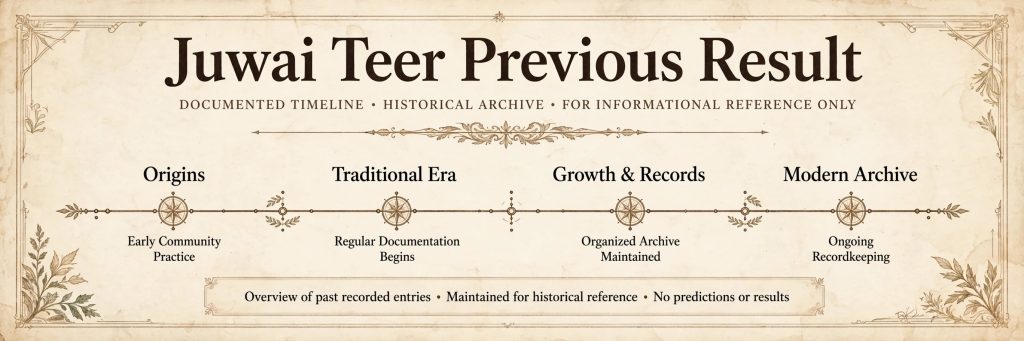
Every juwai teer previous result you read today is a small piece of a much longer story. Behind the tidy rows of dates and numbers lies a traditional archery game that grew into a regulated lottery, and behind the archive lies a history of how ordinary people kept track of results long before the internet existed. This article tells that story: where Juwai teer came from, how its results were recorded through the decades, and how the modern archive carries that tradition forward.
Juwai teer is a legal archery based lottery played in Meghalaya. Each working day, archers shoot at targets in two rounds, officials count the hits, and the last two digits of each count become the FR and SR winning numbers. Teer Result Now publishes the live numbers on our homepage as they are declared, and every finished day joins the dated archive so that any juwai teer previous result remains part of the permanent public record.

Where Juwai Teer Comes From
To understand the records, start with the game. Teer is rooted in the archery culture of the Khasi people of Meghalaya, for whom the bow and arrow were historically tools of hunting and symbols of skill. Archery contests were community events, occasions for villages to gather and for marksmen to display their ability. Over time, these contests took on an organised form, and the counting of hits became the basis of a lottery that the state chose to regulate rather than prohibit.
Juwai, a town in the Jaintia Hills, developed its own teer tradition within this wider culture. The Juwai game follows the same core method as the better known Shillong game: archers shoot, hits are counted, and the last two digits decide the result. But it is its own game with its own ground, its own archers, and its own declaration timings. That independence is exactly why a juwai teer previous result must always be read as Juwai’s own history, never borrowed from another market’s records.
From contest to regulated lottery
The journey from village contest to state regulated lottery took decades. As teer grew in popularity, the need for clear rules, honest counting, and public declarations became obvious. Regulation brought structure: licensed organisers, fixed procedures for counting, and official announcements of results. With regulation came the expectation that results would be public and verifiable, which planted the seed of everything the modern archive does.
How Results Were Recorded Before the Internet
For most of teer’s history, a juwai teer previous result lived in people’s memories, notebooks, and conversations. The declaration happened at the ground, often announced aloud. Those present memorised the numbers or wrote them down on whatever paper was handy. By evening, the numbers had travelled through the town by word of mouth, and by the next morning they had reached the surrounding villages.
The notebook era
Serious followers kept dedicated notebooks. Each page carried a date, and under it the FR and SR numbers, sometimes with the morning session noted separately. These notebooks were personal archives, and their keepers took pride in their completeness. A well kept notebook was a social asset. When a dispute arose about last week’s number, the person with the neatest notebook won the argument.
The limits of memory and paper
But paper has weaknesses. Notebooks get lost, pages tear, ink fades, and handwriting gets misread. A hurried “3” becomes an “8”. A missing date makes a whole page useless. And word of mouth, the fastest channel of the era, was also the least reliable. A number repeated through five people often arrived changed, like a message in a game of telephone. The community developed verification habits, comparing notebooks and asking multiple witnesses, but the system was always one lost notebook away from losing history.

The Digital Archive – How History Became Permanent
The internet changed result keeping the way the printing press changed books. When teer results moved online, every juwai teer previous result gained three protections it never had before: it could not be lost, it could not fade, and it could be checked by anyone at any time.
What changed for the better
First, permanence. A digital entry does not tear or smudge. The numbers published on a date stay exactly as published, year after year. Second, access. A notebook served one owner. An online archive serves everyone with a phone, which means a disputed number can be settled anywhere in seconds. Third, structure. Digital lists enforce the format: date, market label, FR, SR, in that order, every time. The discipline that careful notebook keepers imposed on themselves is now built into the system.
What stayed the same
Interestingly, the core habits did not change. The best digital archives follow the same principles as the best notebooks: date everything, separate the sessions, record exactly what was declared, and never rewrite the past. The medium is new. The wisdom is old. When you browse a juwai teer previous result in our archive, you are using the great grandchild of those handwritten pages, and it honours them by keeping their rules.
How a Single Day Becomes a Permanent Record
It is worth following one day’s journey from live event to historical record, because it shows how much care sits behind each quiet row in the archive.
The day begins with the archery sessions. For the Juwai day game, the first round shooting happens in the early afternoon. Archers shoot their arrows, officials count the hits with witnesses present, and the last two digits of the count are announced as the FR number. The same process repeats for the second round a little later, producing the SR number. The morning session follows the same pattern earlier in the day as a separate game.
As soon as each round is declared at the ground, the number travels to result publishers. Our team collects it from at least two independent sources and publishes it only when they agree. During the day, the entry is live: real numbers appear as they are declared, and dashes “-” hold the places of rounds still to come. By evening, both rounds are settled. Overnight, the completed entry takes its place in the dated list, newest first, and the day officially becomes history. That is how a juwai teer previous result is born: an afternoon of archery, an evening of verification, and a permanent row in the ledger.
For today’s live declarations as they happen, visit our juwai teer result page.

Why Preserving Juwai Teer Previous Result Records Matters
Keeping old results is not nostalgia. It serves real purposes that the teer community relies on every day.
It keeps the game honest. A public, permanent, dated record means no declared number can be quietly changed later. Transparency is the foundation of trust in any lottery, and the archive is transparency made visible.
It settles disputes. Friendly arguments about past numbers are part of teer culture. The archive ends them in seconds with dated proof, keeping the social side of the game pleasant.
It teaches newcomers. A beginner who browses past entries learns the game’s structure naturally: two rounds, two sessions, dates on everything. The archive is the best teacher teer has.
It protects followers. When every juwai teer previous result is checkable, false numbers cannot survive long. Anyone can verify any claim against the record, which starves rumours of oxygen.
How to Read Juwai Teer Previous Result History Correctly
History rewards careful readers. Here is how to read the archive with a historian’s eye.
Always start with the date
The date is the identity of every entry. Read day, month and year together before looking at any number. A juwai teer previous result without a confirmed date is not a fact yet, just a pair of digits.
Respect the session boundary
Juwai morning and Juwai day are separate games with separate histories. Their records sit under separate labels. Crossing that boundary mixes two histories into one fiction, so keep them apart in your reading and in your notes.
Understand the dash
The dash “-” is a placeholder meaning not declared yet or not held. On settled past dates both numbers are filled. On the live day, dashes mark rounds still to come. On Sundays and holidays there is no entry at all, because there was no game.
Compare like with like
When looking across dates, compare FR with FR and SR with SR, morning with morning, day with day. The archive’s consistent format makes this easy, but only if you keep the categories straight in your own reading.

The Juwai Teer Previous Result Archive as a Living Document
A good archive is never finished. Every working day adds a new row, and the story grows by one page. This living quality is part of what makes the juwai teer previous result collection special. It is not a museum piece behind glass. It is a working tool that the community uses daily, and each use, each verification, each settled debate, keeps it alive and relevant.
Our role as publishers is stewardship. We collect declared numbers carefully, verify them against multiple sources, publish them promptly, and preserve them permanently. We never invent numbers, never rewrite old entries, and never mix predictions into the record. You can read about our approach on our about us page.
For wider context on the game, the teer overview on Wikipedia traces its background, and the Government of Meghalaya portal provides official state information.
A Responsible Note on History
Old results describe the past. They do not predict the future, because every round is a fresh archery session with no memory of the rounds before it. Enjoy the history, use it to confirm and to learn, but never let it persuade you to spend more than you planned. This site publishes no predictions, no common numbers, and no betting advice of any kind.
Teer is a legal lottery in Meghalaya, open only to adults aged 18 and above. Please participate responsibly and within limits you set for yourself.

Milestones in Juwai Teer Record Keeping
The story of the juwai teer previous result record has a few clear turning points. The first was regulation itself. When teer moved from informal contests to a state regulated lottery, declarations became official acts rather than casual announcements. An official declaration needs an official record, and that expectation changed how seriously results were documented.
The second milestone was the telephone era. As phones spread through Meghalaya, results could be confirmed by a quick call instead of a day’s wait. Counter owners began phoning in numbers, and followers began phoning to verify. Speed improved, though accuracy still depended on hearing correctly.
The third milestone was the internet era, when the first result websites appeared. Suddenly a juwai teer previous result was not just today’s news but a searchable history. Archives began accumulating, and for the first time the full past of the game sat in one place, open to all. Each milestone made the record faster, more accurate, and more public, and the archive you use today is the sum of all three.
How the Archive Handles Special Days
Not every date on the calendar is a playing day, and a good archive handles the exceptions gracefully. Sundays are rest days with no game and no entry. Public holidays may also pause the game, and festival periods in Meghalaya sometimes bring schedule changes. On such days the archive simply has no row for that date, which is the correct and honest representation.
Occasionally a declaration runs late because counting at the ground takes longer than usual. On those days the live entry may show dashes longer than expected before filling in. Patience is the right response. The numbers appear once they are officially declared, and the archive is updated the same day. A delayed declaration is not a missing record. It is a record taking its time to be accurate, which is exactly what you want from a public ledger.
How Teer Result Now Builds the Juwai Teer Previous Result Archive
Behind every quiet row in our archive sits a careful daily process. It starts at the teer ground in Juwai, where the day’s archery rounds are shot and the official count is announced. Our team records the declared number and then checks it against at least one fully independent source before anything goes on the page. A number is published only when two sources agree, and that verification habit is the main reason readers trust our history.
Once the morning and day sessions are both complete and verified, the finished entry moves into the dated result list in newest first order. Entries are never edited after that point. If a declaration was delayed, the entry is filled in on the same day it is announced, never rewritten later. Sundays and public holidays simply have no entry, because no game was played and there is nothing honest to print.
We also keep the morning and day histories strictly separate, with clear market labels on every entry so readers never confuse the two sessions. Internal links connect each archive row back to the live Juwai teer result page and the main result list, so moving between today’s numbers and any juwai teer previous result takes a single click. It is a simple system built on discipline: collect carefully, verify twice, publish promptly, and preserve permanently. Nothing in it involves prediction, and no predicted number is ever allowed near the record.
FAQs About Juwai Teer Previous Result
How long has Juwai teer been played?
Teer grew out of the traditional archery culture of Meghalaya’s Khasi and Jaintia hills and developed into its organised, regulated form over several decades. Juwai’s game is part of that longer tradition, with its own ground and its own community of followers.
Where can I find the juwai teer previous result for a specific past date?
Open the teer result list page and find the Juwai section. Entries are ordered newest first with full dates, so scroll or search to your date and read the FR and SR numbers beside it.
Why are old results kept publicly instead of being removed?
Because a lottery’s credibility depends on transparency. A permanent public record lets anyone verify any past declaration, which keeps the game honest and settles disputes with dated proof.
Did people keep previous result records before the internet?
Yes. Followers kept handwritten notebooks with dates and daily numbers, and results travelled by word of mouth. The digital juwai teer previous result archive follows the same principles, date everything and record exactly, with far greater permanence and reach.
What is the difference between Juwai morning and Juwai day historical records?
They are histories of two separate games. The morning session and the day session have different archers, timings, and numbers. Their previous results are recorded under separate labels and must never be mixed.
Can studying old results help predict future winning numbers?
No. Each round is an independent archery session, so past numbers have no influence on future ones. The archive is for confirmation, learning, and record keeping, never for prediction.
How does a day’s result become part of the permanent archive?
After both rounds are declared and verified against multiple sources, the completed entry joins the dated list in newest first order. From that point it is a permanent juwai teer previous result, preserved exactly as declared.
Who maintains the previous result archive?
Our editorial team maintains it daily. Declared numbers are collected from multiple independent sources, published only when the sources agree, and preserved permanently with their dates. Past entries are never rewritten and no predicted numbers are ever added, which keeps the juwai teer previous result archive a clean public record.
Conclusion
The juwai teer previous result archive is more than a list of numbers. It is the continuation of a decades old habit of careful record keeping, carried from spoken announcements to notebooks to the digital ledger you read today. Use it to confirm numbers, to learn the game’s structure, and to settle debates with dated facts. Respect its discipline: dates first, sessions separate, predictions nowhere. Share the archive habit with newcomers so the next generation of followers starts with good practices. In return, it will give you something rare in the world of games: a history you can trust completely.
Teer is a legal lottery in Meghalaya for adults aged 18 and above. Please play responsibly.