
The juwai morning teer result is the earliest declared outcome of the day from the archery based lottery played at Jowai in Meghalaya, and for thousands of followers it is the first number they check before the day begins. Unlike the afternoon sessions that most people know from Shillong, the Jowai morning session runs on its own clock, with its own archers, its own counting process and its own moment when the first round number is announced. If you have ever opened a result page at mid morning and wondered whether the number you see is the first round or the second, whether it is confirmed or still a rumor, this guide is written for you. It walks through the entire morning declaration timeline step by step, from what happens on the ground before a single arrow is shot to the exact routine you can use to follow the result live without confusion.
Teer itself is a traditional archery lottery of Meghalaya, where licensed archers shoot arrows at a target and the last two digits of the total arrow count become the winning number. The game is organized locally and is recognized as a legal lottery in the state, which is why its results are declared openly and shared widely. You can read more about the background of the game on Wikipedia. Jowai, the headquarters of the West Jaintia Hills district, runs both morning and afternoon sessions, and the morning session is the one this guide covers in full detail. For a complete day by day archive of outcomes from this centre, you can always visit the Juwai teer result page on Teer Result Now.
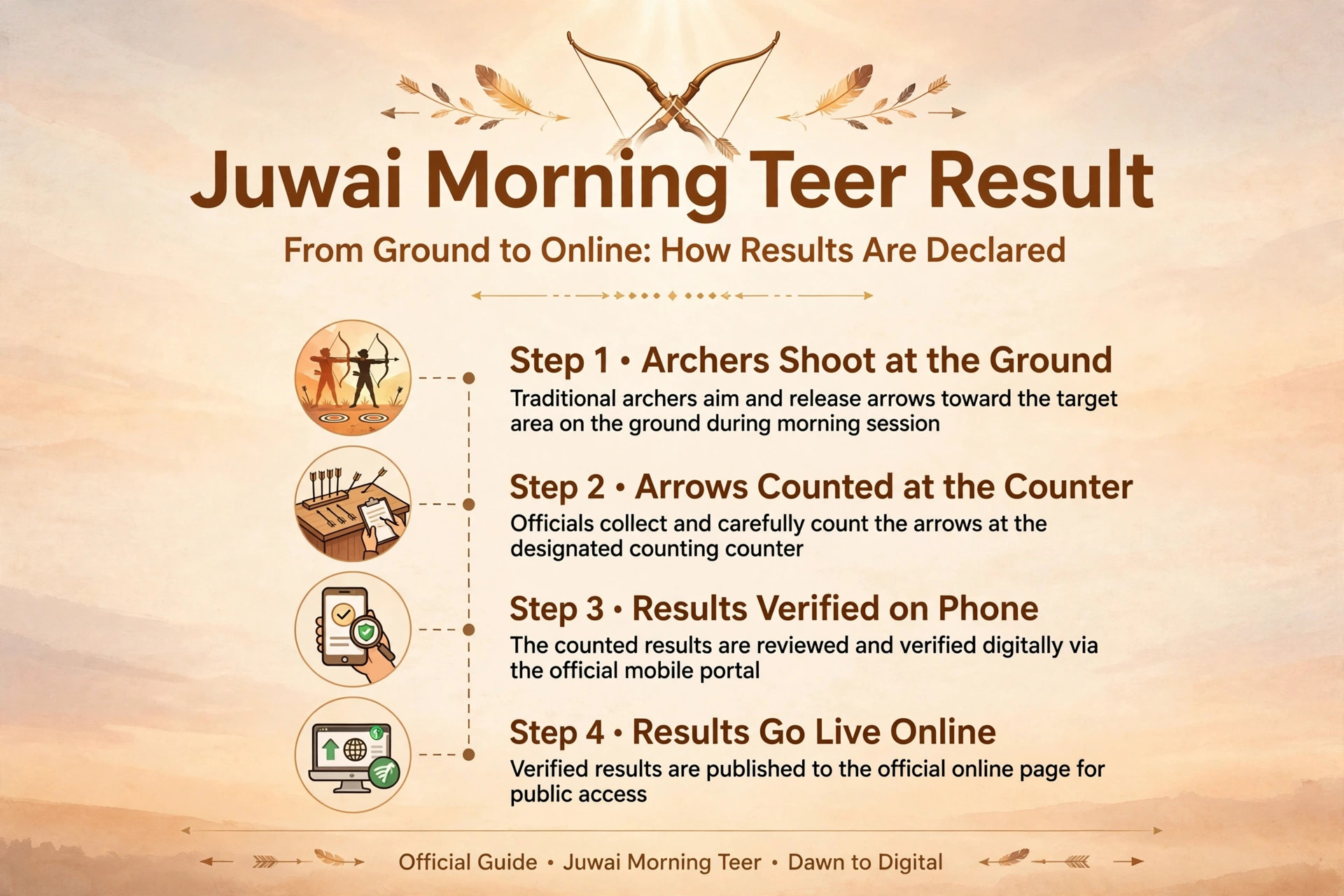
What the Juwai Morning Session Actually Is
Before following any timeline, it helps to understand what the morning session is and how it differs from the rest of the day. The Jowai centre conducts its archery shooting in sessions, and the morning session is a self contained event with two rounds, known as the first round (FR) and the second round (SR). Each round produces one winning number, so one morning session gives you two numbers: the morning FR number and the morning SR number. Together these two numbers make up the full juwai morning teer result for that day.
How morning teer juwai differs from the afternoon game
The afternoon and evening sessions at Jowai and Shillong draw the biggest crowds, but the morning session has its own character. It starts earlier, finishes before midday, and serves followers who want their numbers settled before lunch. The format is identical to other sessions (archers shoot, arrows are counted, the last two digits form the result), but the timing changes everything about how you follow it. Because the declaration happens in the morning, the online update wave hits result websites while most of the day is still ahead, which means pages refresh in a tight window and confusion spreads fast if you check at the wrong minute.
The two rounds that form the juwai teer morning result
Every morning session is built from two rounds of shooting. In the first round, a set number of archers shoot a set number of arrows each at the target, and officials count every arrow that hits. In the second round the same process repeats. The count from each round is reduced to its last two digits, and that two digit figure is the winning number for that round. Both rounds are needed for the day to feel complete, because many followers track FR and SR as a pair, compare them, and record them together in their personal lists. The timeline below treats each round as its own stage so you always know which number you are looking at.
Who declares the number and why it matters
The declaration is done by the officials and counters present at the Jowai ground. They are the single source of truth for the morning. Every website, message group and notice board that publishes the juwai morning teer result is downstream of that counting table. Understanding this chain matters because it explains delays: if the counting takes longer on a given day, every downstream page is late by the same amount, and no website can publish a confirmed number before the ground declares it. Any number you see online before the ground declaration time is unconfirmed by definition.
The Juwai Morning Teer Result Declaration Timeline
This is the heart of the guide. The morning moves through clear stages, and once you know them you can look at the clock and know exactly what should be happening right now. Times below describe the usual flow of a morning session at Jowai; treat them as the pattern to expect rather than a promise, because the ground runs on real world conditions and small shifts are normal.
Stage 1 – Ground preparation and ticket sales close
Long before any arrow flies, the morning begins with preparation at the ground. Archers arrive, targets are set up, officials take their positions and the counters prepare their sheets. Ticket sales for the morning session close before shooting starts, and this cutoff is the first milestone of the day. Nothing is declared at this stage, but it is the point where the morning becomes fixed: the pool of tickets is closed, the archers are confirmed, and the session is committed to run. If you are following from home, this is a good time to open your result page and make sure it loads properly, because the next stages move quickly.
Stage 2 – First round shooting begins
The archers take their positions and the first round shooting starts. Each archer shoots the fixed number of arrows for the round while officials watch and record. This stage is purely physical: bows drawn, arrows loosed, targets struck. It lasts long enough for every archer to complete their quota, and during this time there is nothing to publish yet. Experienced followers use this window to get ready rather than to refresh pages, because refreshing during the shooting itself only shows you the previous day’s numbers or a blank placeholder.

Stage 3 – First round counting and the FR declaration
Once the shooting stops, the counting begins. Officials collect the arrows, count the hits carefully, and cross check the totals. This is the most important moment of the morning, because the number that comes out of this count is the FR number. When the counters agree, the FR result is declared at the ground. It is announced to those present and passed to the people who relay results outward. From this second onward, the FR number exists as a confirmed fact. Everything published online after this point should match what the ground declared.
Stage 4 – The FR publication wave
The moment the FR is declared, a publication wave starts. The number moves from the ground to notice boards, to local relay networks, and then to result websites. This is where Teer Result Now and similar pages pick it up and post it. Because many sites update within minutes of each other, you will often see the FR number appear on several pages in a short burst. A good habit at this stage is to check two independent pages and confirm they show the same FR number before you record it. If one page shows a number and another still shows yesterday’s, the slower page simply has not updated yet; wait for the wave to pass rather than assuming a conflict.
Stage 5 – Second round shooting and counting
With the FR settled, the ground resets for the second round. Archers shoot again, officials count again, and the SR number is produced through the same careful process. The gap between the FR declaration and the SR declaration is the natural rhythm of the morning: first round, count, declare, publish, then second round, count, declare, publish. During this stage you already know the FR with confidence, and the only open question is the SR. Resist the urge to treat any early SR chatter as final; the SR number is only real once the ground’s counters finish and declare it.
Stage 6 – The SR declaration and the morning wrap
The SR count is finalized and declared, and the second publication wave moves it online. At this point the morning session is complete: both numbers of the juwai morning teer result are public, confirmed, and archived. Result pages update their morning sections, daily lists get their new row, and the ground prepares for the afternoon session later in the day. For you as a follower, this is the moment to do a final verification: confirm that both the FR and the SR on your page match a second source, then record them. The morning is done, and anything published after this point about the morning session should be treated as archive material, not live news.

How the Juwai Morning Teer Result Reaches the Internet
Knowing the ground timeline is only half the picture. The other half is understanding the chain that carries the declared number from the counting table to the screen in your hand. When you understand this chain, you stop being confused by delays, mismatches and half updated pages.
The relay chain from ground to screen
Think of the result as traveling through stations. Station one is the counting table at the Jowai ground, where officials finalize the number. Station two is the local relay: the number is announced at the ground, written on notice boards, and passed by phone or message to local distributors and result relays. Station three is the publishing layer: websites like Teer Result Now receive the relayed number and post it on their morning result sections. Station four is you, the reader, refreshing the page. Each station adds a small delay, which is why the number appears online a few minutes after it is declared at the ground, never before. If a website ever shows a morning number suspiciously early, treat it as unconfirmed until the ground timeline says the declaration should have happened.
Why result pages update in waves
You will notice that result websites do not all update at the same second. One page shows the new FR while another still shows the previous day. This is normal and it comes from the relay chain: different publishers receive the relay at slightly different moments, and each site has its own posting routine. The practical rule is simple. During the declaration window, expect a wave, not a single synchronized flash. Give the wave ten to fifteen minutes to pass, then compare. Pages that agree after the wave are showing the confirmed number; a page that lags behind is just slow, not wrong in a way you need to worry about, as long as you verify against a second source.
How to tell a confirmed number from a rumor
Three checks separate a confirmed juwai morning teer result from noise. First, timing: the number appears at or after the expected declaration window for its round, never long before. Second, agreement: at least two independent result pages show the same number. Third, labeling: the page clearly marks it as FR or SR for the morning session of today, not the afternoon session and not yesterday. If a message or post fails any of these checks, wait. The confirmed number will arrive through the normal wave, and waiting a few minutes costs you nothing while acting on a rumor can mislead your whole record for the day.
What delays actually mean
Sometimes the morning runs late. Counting can take longer, the relay can be slow, or a website can have a technical hiccup. A delay almost never means the result is cancelled; it means one of the stations in the chain is running behind. The worst response to a delay is to fill the gap with a guessed number from an unverified message. The best response is the routine described in the next section: check at the right times, verify across sources, and let the wave finish. Patience during a delay is what separates followers who keep clean records from followers who chase noise.

The Best Routine for Following the Result Live
Here is a practical routine built directly on the timeline above. It is designed for a normal morning and it keeps you ahead of confusion without chaining you to a refresh button.
Step 1 – Prepare before the shooting starts
Open your result page early, while the ground is still in the preparation stage. Confirm the page loads, find the morning section, and note what it currently shows (it will usually be the previous day until the new declaration arrives). This is also the moment to decide which second source you will use for verification, so you are not hunting for one in the middle of the publication wave. A calm setup now prevents frantic checking later.
Step 2 – Check once for the FR after the declaration window
Instead of refreshing continuously through the shooting and counting, wait until the FR declaration window has plausibly passed, then check once. If the FR is posted, verify it against your second source. If it is not posted yet, wait ten minutes and check again rather than refreshing every thirty seconds. One deliberate check beats fifty anxious ones, because the number appears in the wave whether you watch it arrive or not.
Step 3 – Confirm the FR, then stand by for the SR
Once two sources agree on the FR, record it and relax. The ground is now in the second round stage, and there is nothing to do but wait for the SR wave. This is the stage where most confusion happens, because impatience peaks: followers start treating guesses as news. Hold your routine. The SR will be declared, the wave will carry it, and your two source check will confirm it just like it confirmed the FR.
Step 4 – Do a final two source verification
When the SR appears and your sources agree, do one last verification pass over the complete morning: FR and SR, both confirmed, both labeled as today’s morning session. Record them together. Then close the loop for the morning. Your record is now as reliable as the public declaration chain allows, and you achieved it with four calm checks instead of a morning of refreshing.
Tools that help and habits that hurt
A bookmarked result page and a short list of two or three trusted pages help enormously. Message forwards, on the other hand, hurt: they strip away timing and labeling, so a forwarded FR from yesterday can look exactly like today’s. If a number reaches you through a forward, run it through the three confirmation checks before you believe it. And never let a single screenshot be your only source; screenshots are easy to edit and impossible to verify. The live page, checked twice, is always the stronger evidence.

The Morning Teer Juwai List and Daily Archives
Beyond the live moment, the juwai morning teer result lives on in lists and archives. A daily list records each day’s morning FR and SR in one row, building a history you can scroll back through. Archives matter for three practical reasons. First, they let you verify what was declared on any past date, which settles disputes about what the number “really was.” Second, they reveal the rhythm of the game across weeks and months, which is interesting in its own right as a record of a living tradition. Third, they are the raw material for anyone who studies the game seriously, because every analysis starts from a clean, dated record.
When you use an archive, check that it separates morning from afternoon clearly and labels FR and SR for each session. A well kept list, such as the archive on the teer result list page, keeps each session in its own lane so you never mistake an afternoon number for a morning one. Build the habit of recording each morning’s pair in your own notebook or sheet as well; your personal log, kept consistently, becomes a private archive that no website outage can take away from you.
A Note on Responsible Play
Teer is a legal lottery in Meghalaya, operated under the state’s lottery framework. You can learn about the state’s official administration on meghalaya.gov.in. Participation is strictly for adults aged 18 and above. Treat teer as entertainment with a fixed, affordable budget, never as a source of income and never with money you cannot afford to lose. If playing stops being fun, step away. This guide exists to help you follow the juwai morning teer result clearly and calmly; it is not betting advice, and it contains no predictions, targets, or tips of any kind. Play responsibly, and keep the morning ritual enjoyable.
Juwai Morning Teer Result FAQs
What time is the juwai morning teer result declared?
The morning session at Jowai runs in the morning hours, with the first round declared first and the second round declared after the second shooting and counting are complete. Exact minutes vary from day to day because the ground works through real shooting and careful counting, so follow the stage by stage timeline in this guide rather than a single fixed minute. The FR wave reaches result pages first, and the SR wave follows once the second round is declared.
What is the difference between FR and SR in the morning session?
FR (first round) and SR (second round) are the two independent rounds of archery shooting that make up one morning session. Each round produces its own winning number from its own count of arrows. The full juwai morning teer result for a day is the pair: the morning FR number plus the morning SR number. Always record and verify them as a labeled pair so the two are never mixed up.
Why do different websites show different numbers for the same morning?
In almost every case this is a timing artifact, not a real disagreement. Result pages update in a wave after each declaration, so during the wave one page may show the fresh number while another still shows the previous day. Wait for the wave to pass, then compare again. If two independent pages agree after the wave, that is the confirmed number. Persistent disagreement long after the wave is rare and usually means one page failed to update; the agreeing majority is the reliable signal.
Can I get the juwai morning teer result today before it is declared?
No. The result does not exist before the ground counts and declares it. Any number circulating before the declaration window is unconfirmed by definition, regardless of how confidently it is presented. The only numbers worth recording are the ones that arrive through the normal declaration and publication wave and pass the two source check. For the latest confirmed updates throughout the day, the Teer Result Now homepage keeps the current sessions in one place.
Where can I find old juwai morning teer results?
Daily archives keep past mornings organized by date, with FR and SR labeled per session. Use an archive that clearly separates morning from afternoon sessions so you are reading the right row. Keeping your own dated log alongside the online archive gives you a personal backup that is always at hand. If you want to know more about how this site maintains its result pages, the about us page explains the approach.
Is the morning session connected to the afternoon session?
They are separate sessions at the same centre. The morning session completes fully (FR declared, SR declared) before the afternoon session begins, and each session’s numbers stand on their own. Following the morning timeline in this guide covers the morning completely; the afternoon follows its own later timeline with its own declarations.
What should I do if the morning result seems delayed?
Stay with the routine: wait for the wave, check your two sources, and do not fill the gap with unverified numbers. Delays in counting or relay are normal occasional events and the declaration still arrives. If a delay stretches unusually long, it still does not justify trusting a rumor; the confirmed number is worth the wait, and your record stays clean because you waited for it.
Conclusion
Following the juwai morning teer result well is less about speed and more about rhythm. The morning moves through preparation, first round shooting, FR counting and declaration, the FR publication wave, second round shooting, SR declaration, and the final wrap. Each stage has its own job, and your job as a follower is simply to meet each stage at the right time: prepare early, check deliberately, verify across two sources, and record the pair. Do that, and every morning gives you a clean, confirmed record with none of the confusion that comes from chasing rumors. Keep this timeline handy, follow the routine, and the morning session will always make sense.